
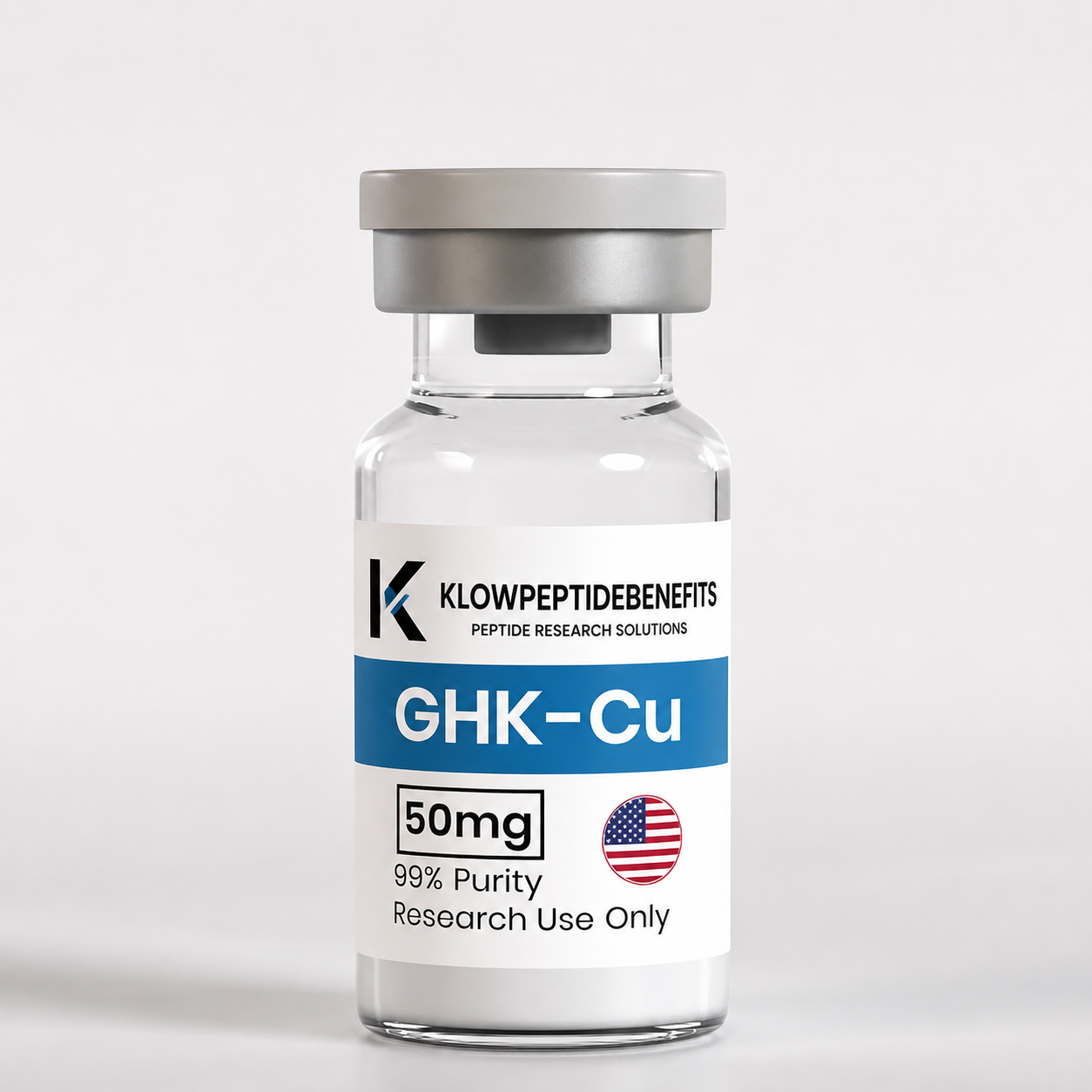


ghk cu buy
Price range: $50.00 through $210.00
GHK-Cu is a copper-peptide complex that has long piqued scientists’ interest. Studies have looked into its effects on extracellular matrix biology, collagen-related processes, fibroblast activity, skin remodeling, and tissue repair.
GHK-CU PEPTIDE INJECTION BUY ONLINE
What Is GHK-Cu?
If you are researching what is ghk-cu, GHK-Cu is a copper-containing complex formed from the naturally occurring tripeptide GHK, which stands for glycyl-L-histidyl-L-lysine. GHK has a strong ability to bind copper ions, forming the GHK-Cu complex. Researchers have studied this molecule for decades because of its potential role in skin biology, tissue remodeling, and extracellular-matrix processes. Buy GHK-Cu, ghk-cu peptide injection where to buy
The term ghk-cu refers to this copper-peptide complex. It is also commonly described as copper tripeptide-1 in cosmetic and skincare discussions. The molecule has attracted particular interest because GHK-Cu has been investigated in relation to collagen, elastin, fibroblast activity, wound-healing processes, and skin remodeling.
A ghk cu peptide should therefore be understood as a peptide-copper complex rather than simply a source of copper. The peptide component and copper component work together to create the molecular form that has been studied in laboratory, cosmetic, and other research settings.
The scientific interest in GHK-Cu comes from its biological activity. Research has identified effects involving extracellular-matrix proteins and cellular signaling. However, the strength of evidence varies depending on the particular use being discussed. Laboratory findings should not automatically be treated as proof of a specific clinical benefit in humans.
How Does Buy GHK-Cu Work?
A common question is what is ghk cu and how it differs from ordinary copper-containing ingredients. GHK-Cu is different because copper is bound to the GHK tripeptide. This complex has been investigated for its interaction with biological systems involved in tissue remodeling and skin structure.
Research suggests that GHK and GHK-Cu can influence processes involving fibroblasts, collagen, elastin, glycosaminoglycans, and other extracellular-matrix components. These processes are important because the extracellular matrix helps provide structure and support to skin and other tissues.
Another area of interest is wound-healing biology. Laboratory and preclinical research have examined GHK-Cu in relation to cell migration, tissue remodeling, and repair processes. These findings help explain why GHK-Cu continues to attract attention in cosmetic and regenerative research.
However, mechanism does not automatically equal a proven treatment effect. A substance can produce interesting biological activity in laboratory models while still requiring stronger human clinical research before specific medical claims can be made.
GLOW Benefits and Research Areas
When people search for what does ghk cu do, they are often interested in its potential effects on skin appearance and tissue biology.
GHK-Cu has been investigated for several areas, particularly skin remodeling, collagen-related activity, elasticity, firmness, fine lines, pigmentation, and wound-healing processes. Earlier reviews describe promising biological effects, while newer reviews point out that clinical evidence for topical GHK-Cu remains limited.
Collagen is an important area. GHK-Cu research has focused on its relationship to collagen synthesis and extracellular matrix regulation. Copper peptides are popular cosmetic ingredients because they help to maintain skin structure and firmness.
GHK-Cu has also been investigated in relation to skin elasticity and overall appearance. However, the evidence is not entirely consistent. A randomized study of GHK-Cu skincare after CO₂ laser resurfacing found no significant improvement in wrinkle and skin-quality measurements. However, participants who used the GHK-Cu product reported higher satisfaction with overall skin quality.
This is an important distinction for a high-quality product page. GHK-Cu can have promising research findings without every advertised benefit being clinically established.
A 2025 review also highlighted a major research gap: despite widespread interest in GHK-Cu as a cosmetic ingredient, there are relatively few clinical studies directly evaluating its effectiveness, and questions remain about skin permeability and formulation.
4. GHK-Cu for Skin and Cosmetic Research
GHK-Cu has gained popularity in skincare due to its relationship with extracellular matrix biology.
Topical GHK-Cu has been studied for its potential to influence collagen and skin remodeling processes. The compound’s hydrophilic nature, however, presents a significant formulation challenge because the outer layer of the skin can limit penetration. Recent research has focused on liposomal delivery and other methods for improving skin transport.
This helps to explain why products containing copper peptides vary so greatly. The concentration of the active ingredient is only one consideration. How well a topical product works depends on its overall formulation, stability, delivery system, skin compatibility, and method of application.
For consumers researching glow peptide, it is useful to understand that product names can refer to blends rather than individual molecules. GHK-Cu itself is a specific copper-peptide complex, while names such as GLOW may be used commercially for multi-peptide formulations. Therefore, the ingredient list should always be checked rather than relying only on the product name.
GHK-Cu should also not automatically be considered interchangeable with other copper-containing skincare ingredients. Different formulations may have different concentrations, delivery systems, and supporting ingredients. Buy GHK-Cu

GHK-Cu Dosage, Injection Questions and Safety
Searches for ghk cu dosage are common, but dosage information needs to be separated into topical cosmetic use, laboratory research, and injectable administration.
There is no universally established human injectable dose of GHK-Cu that can responsibly be presented as a standard daily recommendation. Injectable GHK-Cu has limited human safety information, and the FDA has specifically identified potential safety concerns involving immunogenicity, aggregation, and peptide-related impurities in compounded injectable preparations.
For that reason, how much ghk-cu should i inject daily should not be answered with an internet-based number. A person’s appropriate medical treatment cannot be determined from peptide concentration alone. Administration route, formulation, medical history, other medications, and potential adverse reactions all matter.
Similarly, ghk-cu peptide injection dosage per day is not an established general medical dosing standard. Giving a specific injection schedule for an unapproved or compounded injectable product could create a false impression that the dosage has been clinically validated.
This is particularly important because topical and injectable GHK-Cu should not be treated as equivalent. Evidence involving a cosmetic cream or serum cannot automatically establish the safety or effectiveness of injecting the same ingredient.
Anyone considering an injectable peptide should discuss it with a qualified healthcare professional rather than relying on online dosing charts, calculators, or seller instructions.
Is GHK-Cu FDA Approved?
A key question for consumers is is ghk cu fda approved?
The answer requires a key distinction. The FDA regulates drugs and medical products according to their intended use and formulation. The presence of GHK-Cu as an ingredient in cosmetic products does not imply that an injectable GHK-Cu product is FDA approved.
The FDA currently lists GHK-Cu for injectable routes among bulk drug substances, indicating that compounded injectable preparations may pose significant safety risks. The agency acknowledges that there is limited human data to inform safety considerations and identifies potential immunogenicity concerns related to aggregation and peptide impurities.
As a result, a website should not mention injectable GHK-Cu as an FDA-approved injectable treatment.
This distinction is especially important for online peptide stores. A product being labeled “research use only,” “laboratory material,” or “not for human consumption” does not establish that it is safe or approved for injection.
For topical cosmetic products, the regulatory situation is different because cosmetics and drugs are regulated differently. A cosmetic product containing a peptide should therefore be evaluated according to its actual formulation, labeling, intended use, and applicable regulations.

GHK-Cu Pros, Cons and What Buyers Should Know
GHK-Cu has several reasons for its popularity. It has a long history of scientific interest, a well-defined peptide structure, and research covering skin biology, tissue remodeling, extracellular-matrix activity, and cosmetic applications.
Another advantage is that GHK-Cu is relatively well understood at the molecular level. Researchers know that GHK binds copper and that the resulting complex interacts with biological processes relevant to skin and tissue biology. Buy GHK-Cu
However, there are some limitations. The amount of high-quality human clinical evidence is less than the amount of promotional material available on the internet. A recent review specifically mentioned the scarcity of clinical studies involving GHK-Cu and raised unanswered questions about skin permeability and effectiveness. Where to Buy GHK Cu Peptide?
Injectable use raises additional concerns. The FDA has identified potential immunogenicity risks associated with compounded injectable GHK-Cu but notes that human safety data is limited.
As a result, a responsible GHK-Cu product page should avoid claims of guarantyd wrinkle reduction, collagen production, wound healing, or other medical outcomes. Where to Buy GHK Cu Peptide?
| Quantity |
GHK-CU 50mg (Half Kit) ,GHK-CU 50mg (Full Kit) ,GHK-CU 100mg (Single) ,GHK-CU 100mg (Half Kit) ,GHK-CU 100mg (Full Kit) |
|---|
Related products






Reviews
There are no reviews yet.